




 GIFT:
GIFT:
The sacred books of Hinduism, like those of Islam and Christianity, are profoundly sexist.
Read LIVE WITHOUT HARMING! Reform sexism in Islam
Let’s see what the Vedas, the Manusmriti, the Ramayana and the Mahabharata say:
THE VEDAS
They are the oldest and most sacred texts of Hinduism and contain passages that reflect a complex view of women’s role. In the Rigveda, for example, there are hymns that praise women as sages and prophetesses. However, there are also verses that establish a gender hierarchy, as in the Atharvaveda, which describes the wife as subordinate to her husband and emphasizes the importance of her obedience.
THE MANUSMRITI
Also known as the Laws of Manu, it is one of the oldest and most fundamental texts of Hinduism and prescribes detailed norms for social and moral conduct. It is the subject of intense criticism for its clearly sexist precepts.
One of the main criticisms is its view of women as subordinate to men at every stage of their lives. In chapter 5, verse 147, the text states:
“By a girl, by a young woman, or even by an aged one, nothing must be done independently, even in her own house”.
This statement underscores women’s lack of autonomy, as they are seen as subject to male authority.
This subjugation is reinforced in chapter 9, verse 3, which stipulates that a woman must be under the guardianship of her father in childhood, her husband in youth, and her sons in old age. This cycle perpetuates male control and female dependence throughout a woman’s life.
The Manusmriti also regulates aspects of marriage and female chastity with a rigor that is disproportionate compared to the freedoms granted to men. For example, in chapter 9, verse 94, a man is allowed to take another wife if his wife is disobedient or does not bear him children, reinforcing the idea of women as property or a means to an end rather than as persons with rights of their own. Such provisions reinforce gender inequality and perpetuate the perception of women as subordinate to male desires and needs.
In addition, this sacred scripture prescribes severe punishments for women who do not fulfill their traditional roles, while similar transgressions by men are often treated more leniently. This legal and moral double standard not only reflects but also perpetuates a patriarchal system that has profoundly influenced Indian society over the centuries.
THE RAMAYANA
In this book, the character of Sita is seen as the epitome of devotion and purity, but her life is marked by obedience and suffering due to her husband, Rama. Her self-denial and sacrifice are presented as virtues, which has influenced the traditional perception of women’s role.
THE MAHABHARATA
In this epic Hindu text, the treatment of Draupadi—who is publicly humiliated and whose fate is tied to the men in her life—also underscores women’s vulnerability and dependence.
SEXISM IN HINDUISM TODAY
Even today, in traditionalist Hinduism, women are still regarded as someone (or something?) at their husband’s service and there to please him. Therefore, when he dies, she is deemed to have lost her reason for being.
And that is why, traditionally, she was burned alive on the funeral pyre alongside her husband’s corpse. Today, this is prohibited, but even so, in fundamentalist circles there are still a few isolated cases.
What is far more widespread among conservatives is reducing widows to mere castoffs and throwing them out of their homes, with no inheritance rights. Many of them suffer severe abuse and marginalization. According to Hindu tradition, they are seen as bearers of bad luck and are often blamed for their husbands’ deaths. This belief condemns them to a life of isolation and deprivation.
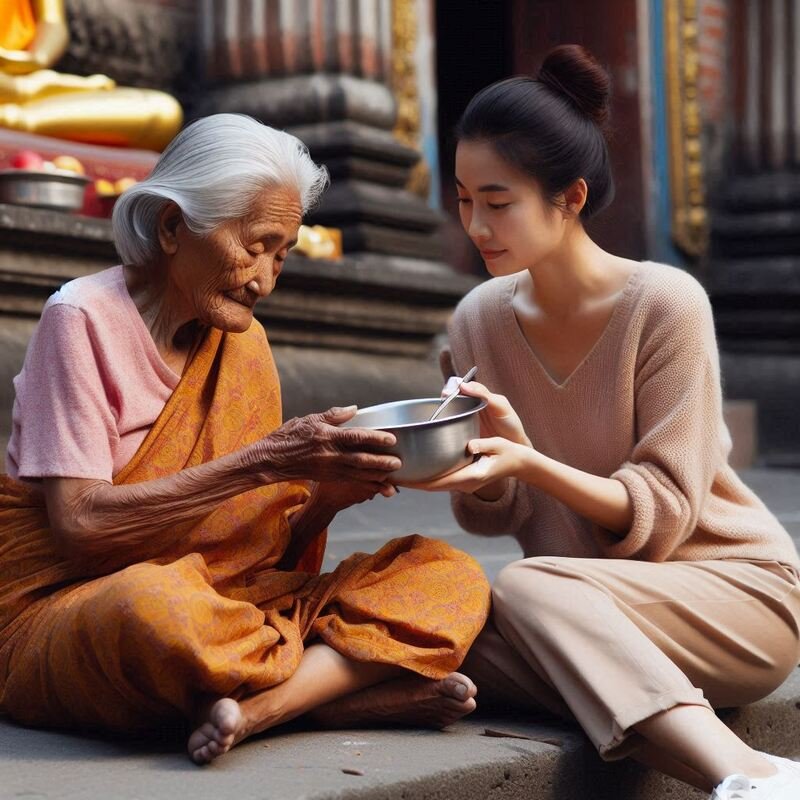
When they become widows, women who are expelled from their homes and stripped of their property are forced to live in ashrams or on the streets, relying on alms or NGOs to survive.
Therefore, the marginalization of widows is both social and economic. Deprived of education and employment opportunities, they often live in extreme poverty. In addition, they suffer physical and emotional abuse, both in public and private spheres, increasing their vulnerability.

LET’S CHANGE THESE INJUSTICES NOW!
Fortunately, some scholars and believers are reinterpreting the sacred texts to promote gender equality. Movements within Hinduism seek to empower women and eradicate discriminatory practices.
Let’s support these movements and help the reform spread.
Read FOR A WORLD WITHOUT HARM: Preserve the good and change the harmful
Read THE REVOLUTION OF LIVING WITHOUT HARMING: SEE the harmful side of religions
Read LIVE WITHOUT HARMING! REFORM the harmful side of religions
Read LIVE WITHOUT HARMING! Choose the best version of each religion
Read HOW TO LIVE WITHOUT HARMING? Push religions to change their harmful side
Thank you for sharing to help improve.

