




 GIFT:
GIFT:
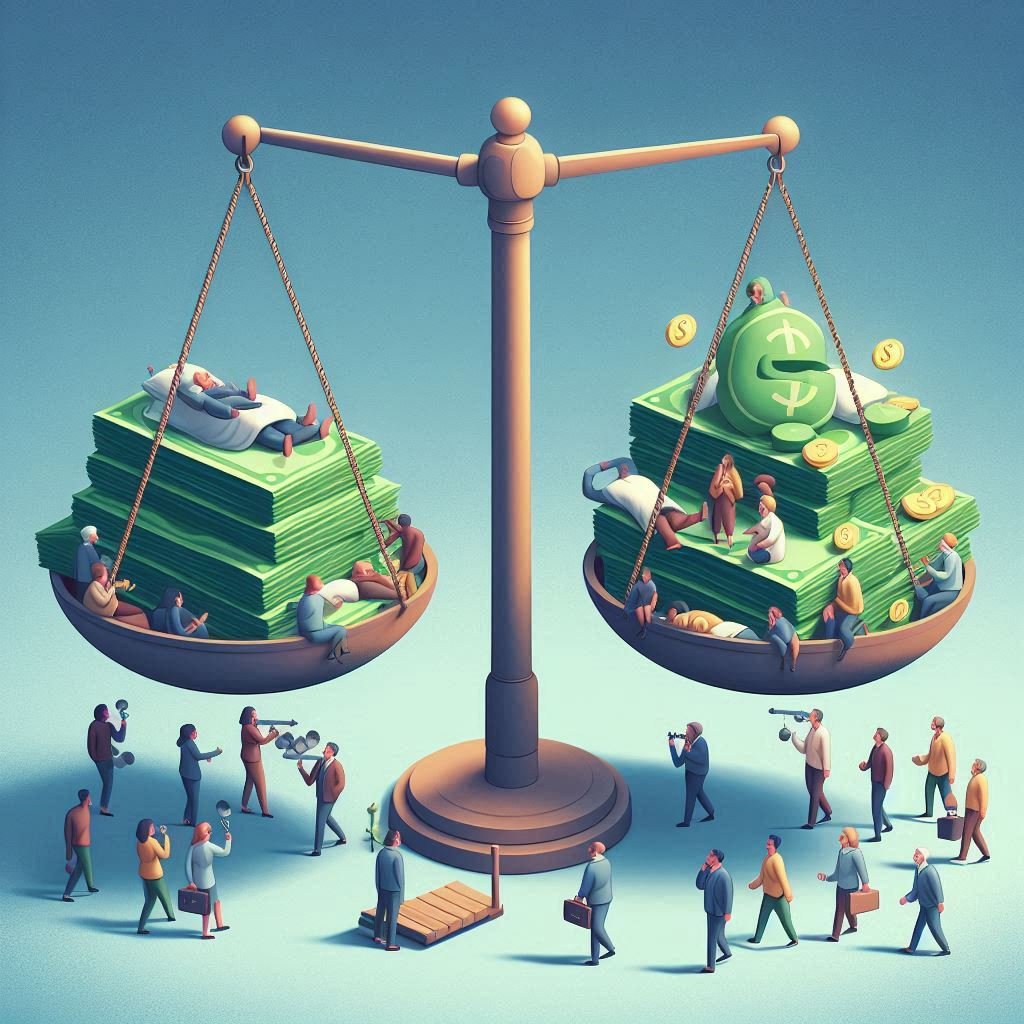
There are politicians who, in exchange for votes, attempt to equate individuals who give their best with those who give minimum effort. This involves, for example, taking a significant portion of the harvest from someone who spends 10 hours a day gathering wild berries and giving it to someone who only spends 4 hours doing the same.
We are not talking about expropriating large estates resulting from plunder through conquest, such as those in Latin America or southern Spain, nor about reasonably correcting economic inequalities—all of which would be justified. Instead, we are referring to an unfair equalization that benefits those who are less hardworking, frugal, responsible, and self-sacrificing at the expense of those who are diligent, forward-thinking, proactive, entrepreneurial and innovative.
It is completely asymmetrical to attempt to equalize the results of effort without equalizing the effort itself. It is inequitable to mutualize income but not stress, fatigue (or exhaustion), leisure time for oneself and one’s family, the deprivation of buying what one would like in order to save and invest, risks, worries, pressures, etc.
DO NOT STEAL! Obtain wealth honestly
DO NOT STEAL! Seek a non-abusive balance between responsibility and solidarity
AVOID HARM! Do not ignore the current far-left threat
Some may argue that there are highly redistributive countries like Sweden that function very well, leading many international rankings. However, this is not exactly the case; while it is true that it has a large welfare state and high taxes to maintain it, it is actually the second most unequal country in the world in terms of wealth, after the United States. It also ranks high in billionaires per 100,000 inhabitants.
It is true that there is remarkable wage equality, but it is also true that native Swedes have a widespread culture of work and responsibility. Being a population with a homogeneous mindset regarding labor and economics, there is a certain balance on both sides of the scale, rather than just one.
On the other hand, there is a heavy tax burden on salaries, but in exchange, taxpayers receive excellent public services. Redistribution is primarily from each taxpayer to themselves: everyone contributes significantly during the most productive stages of their lives and receives a lot when they are not, such as when they cannot work due to old age, illness, parenthood or job loss.
The balance is reinforced by the fact that almost all ethnic Swedes contribute their fair share to the State: nearly everyone works, as it is socially frowned upon not to do so, and all those with earned income pay Income Tax: most at an approximate rate of 32% (depending on the municipality) and those earning more than 613,900 kronor per year (about €53,600), who represent approximately 20% of taxpayers, at an additional rate of 20%.
Furthermore, capital gains (such as dividends or corporate profits) are subject to relatively low taxation, and there are no wealth, inheritance, or gift taxes. This is because, besides contributing significantly to entrepreneurship and wealth generation (thanks to which the country is so wealthy and can afford excellent public services), Swedes find it fair for an entrepreneur to become very wealthy through hard work, initiative, and risk-taking.
To make things worse, indirect taxes such as VAT, which has a general rate of 25%, primarily affect the middle and lower classes, since the lower the income, the higher the proportion spent on consumption taxes.
All this means that, although the Swedish system is progressive and redistributive, in practice, the bulk of the Welfare State is actually paid for by the middle and lower classes through income and indirect taxes.
In the 70s and 80s, Sweden was a country with very socialist policies, but due to their failure, it returned to a more liberal path in the 90s. Today, it is one of the most free, open, and market-oriented economies in the world. It encourages entrepreneurship, innovation, wealth generation, and capitalist accumulation, rewarding them generously. As a result, it has one of the highest ratios of entrepreneurs per 100 inhabitants in the world, as well as successful tech startups, innovation, and per capita income.
In short, native Swedes are almost all “little ants.” Among them, the most entrepreneurial and successful are not equalized with the rest. The “grasshoppers” who want to live off “handouts” instead of working are basically found among the refugee and immigrant population, especially those from Africa and the Middle East. However, the Swedish government, far from equating them with the ants, is implementing three policies to get rid of them:
1. Reducing their social benefits.
3. Offering them money to return to their home countries.
2. Strict border controls to prevent more people of this type from entering Sweden.
Thanks to these measures, the country has ensured that the immigrant population in general, and specifically those with a profile of being lazy or opportunistic, is decreasing rather than increasing.
This policy of avoiding “tick-like grasshoppers” applied by Sweden, Denmark, the Netherlands and increasingly more countries is much fairer and more beneficial for society as a whole than equating them with hardworking little ants. This is what can allow a good welfare state to be maintained and prevent economic and social decline.
If you believe that sharing this information is useful for achieving a fairer world, I encourage you to do so,

