




 GIFT:
GIFT:

Are people born with an inner sense of right and wrong?
Except for psychopaths, all human beings possess an innate sense of right and wrong, though it varies greatly from person to person. This is not the morality we are taught, often capable of both kindness and harm, but a deeper inner faculty we are born with, completely independent of cultural conditioning or instruction.
This ethical compass regulates our basic instincts, which are solely self-interested, promoting a balance in the service of justice.
A combination of studies in developmental psychology, neuroscience, and anthropology provides evidence that justice is not merely a social construct, but a fundamental characteristic of our human nature.
Those of us who have children know that from an early age they show preferences for ethical behavior and an aversion to injustice. Even before being significantly influenced by education, it is observed how, when watching television, they naturally perceive the lion in a documentary eating a zebra or the human in a movie whipping a slave as bad.
An experiment conducted by Yale University provides evidence of the early presence of a sense of justice in humans. In this experiment, researchers showed babies aged six to ten months a series of theatrical performances with puppets, where some helped, while others acted abusively. The results showed that most babies preferred to interact with the first set of puppets.

Furthermore, a study by the University of Washington demonstrated that children as young as 15 months old can distinguish between fair and unfair distributions of resources. Babies observed scenarios where rewards were distributed equitably or inequitably and showed surprise and displeasure in the latter case.
Regarding adults, research from the University of Zurich has proven that their willingness to punish injustice, known as “altruistic punishment,” is present across different cultures. This phenomenon has been observed in economic experiments where participants are willing to sacrifice personal resources to sanction unfair behaviors, demonstrating that ethics is a universal value deeply rooted in human nature.
On a neuroscientific level, researchers at Emory University, using functional magnetic resonance imaging, discovered that certain brain areas, such as the dorsolateral prefrontal cortex and the amygdala, are activated when individuals perceive abuses. This provides a neurological basis for our emotional and cognitive responses to abusive situations.
Experiments with non-human animals have reached similar conclusions. For example, in one experiment, several capuchin monkeys were rewarded for performing the same task differently with pieces of grape, carrot, or rock, and those who were poorly compensated angrily threw the piece at the researcher.
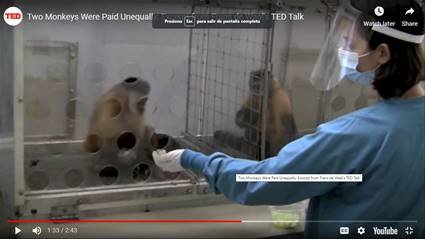
Likewise, it has been observed that if a member of the pack is unfairly attacked by another, the remaining members intervene to defend them.
Our sense of justice matures over time, largely formed between the ages of 20 to 22. The level varies greatly among individuals, which poses a significant challenge. Most people develop an average or low sense of justice, leading them to primarily concern themselves with abuses that affect them, their loved ones, or the groups with which they identify.
We often apply double standards: we become victims when we suffer abuse, but we remain indifferent, minimize, or even justify injustices when they affect people with whom we do not feel connected. This attitude can range from silent complicity to active support of such actions.
Read LIVE WITHOUT HARMING: Be impartial and do not apply double standards
HOW TO LIVE WITHOUT HARMING? Never support injustice
This happens because, by nature, humans tend to focus on satisfying their own needs, those of their children, and, to a lesser extent, those of their loved ones or the interests of the groups with which they identify. Beyond this “microworld,” there is usually little concern for what happens to others or for the suffering of others, even if solidarity is feigned through contributions to NGOs or humanitarian gestures that are well-regarded in society.
FOR A WORLD WITHOUT HARM: Charity does not cancel the harm we cause
THE ART OF LIVING WITHOUT HARMING: Shed your masks of sanctimony
This collective behavior generates mediocre societies: healthy in certain aspects, but deeply harmful in others. We have oscillated between unhinged (and unhinging) extremes, such as when tens of millions of African slaves were sent to the Americas in terrible conditions, and moderately toxic systems. The good news is that this panorama can change. With individual efforts and social reforms, it is possible to heal our communities and build a more just world.
THE REVOLUTION OF LIVING WITHOUT HARMING: Act with fairness
LIVE WITHOUT HARMING! Be a good person
LIVE WITHOUT HARMING: Reform society
HOW TO LIVE WITHOUT HARMING? Continue the civilizing process
The basis for this is to raise the bar for the sense of justice at both individual and societal levels. The first 4 steps are as follows:
- Become aware that harming innocent people is wrong.
- Help others to do so, convincing them not to do to others what they do not want done to themselves
AVOID HARM! Share and persuade so that they do not cause harm
- Educate children and teenagers in the ethics of kindness.
FOR A WORLD WITHOUT HARM: Educate children in the ethics of kindness
- Un-educate, undo the harmful indoctrinations that have corrupted our innate sense of ethics and have led us to amorality, which means believing that harming innocent people in certain cases is not wrong, thus normalizing abuse and indifference to evil.
THE ART OF LIVING WITHOUT HARMING: Do not normalize certain abuses
Change does not require big heroic gestures, but small daily actions that together can change the world. Let us be the example that inspires others and make justice a universal value.
Each of us has the power to make a difference. A fairer world begins with you.
Thank you for acting and sharing,

