




 GIFT:
GIFT:
JAMES I OF ARAGON

In Catalonia, Valencia, and the Balearic Islands, James I of Aragon is still honored, especially by nationalists, for conquering the Balearic Islands and Valencia, thus being considered the father of what some call the “Païssos Catalans” (territories where the Catalan/Valencian language is spoken).
His father, Peter II, had lost considerable territories north of the Pyrenees to the King of France in the Battle of Muret—roughly what is now Provence and the Occitania region. When his son James I succeeded him, he found that after the loss of those lands, he was left only with the County of Barcelona, the Kingdom of Aragon, and the Lordship of Montpellier, significantly less than what his father had possessed.
Since he was not satisfied with that, pobrissó (poor thing), he compensated by conquering new territories. The first was Mallorca, where he committed genocide against practically its entire population, later repopulating it primarily with what we would today call Catalans, French, and to a lesser extent, Italians.
Read LIVE WITHOUT HARMING! Fight for human rights
As this was not enough for his ambitions, he conquered the island of Ibiza. However, being very magnanimous, he spared the lives of its inhabitants and turned them all into slaves. Next came the region of Valencia, where, in an act of kindness, he limited himself to plundering the lands, houses, and wealth of its inhabitants to give them to the new Aragonese, Catalan, French, and Navarrese settlers.
Read LIVE WITHOUT HARMING: Rebel against slavery, including covert slavery
If someone were to commit such outrages today, they would be condemned in the International Court of Justice in The Hague for crimes against humanity. Nevertheless, in Catalonia, Valencia, and the Balearic Islands, monuments, major street names and even a university are dedicated to him.
Unlike countries such as France or Germany, where there is a tendency to remove icono-villains from public spaces or recontextualize them, this process of moral cleansing is not taking place in these lands.
Read HONOR NO VILLAIN! Charlemagne, Louis XIV, Napoleon
Read HONOR NO VILLAIN! Bismarck, Frederick the Great, Adenauer
THE CATHOLIC MONARCHS

The main reference points for Spanish nationalism are Isabella of Castile and Ferdinand of Aragon, as they were the founders of Spain, completed the Reconquista, and initiated the Spanish Empire. They are considered the cornerstone of the nation, at the center of the arch, flanked by two other great stones: Don Pelayo on the right and Charles I of Spain and V of Germany on the left.
Read HOW TO LIVE WITHOUT HARMING? Question the nationalist narratives that cause conflict
Read FOR A WORLD WITHOUT HARM: Undo the identity indoctrination that distances us from others
But the reality is that the Catholic Monarchs committed large-scale crimes whose resulting suffering was in no way inferior to those of James I:
- Ferdinand I of Aragon subjected the conquered inhabitants of Malaga to slavery.
- Later, his wife Isabella did the same with the inhabitants of the fallen Kingdom of Granada.
- Subsequently, she did so with the Guanches, the natives of the conquered Canary Islands—or rather, with those who had not committed suicide by throwing themselves off cliffs to avoid enslavement.
- As this was not enough to satisfy their greed, they then conquered America, stole the lands and wealth of the indigenous people, and subjected them to the encomienda system—a type of servitude or forced labor theoretically less burdensome than slavery, but which in practice was often similar.
- Furthermore, they expelled the Jews from Spain.
- And, as if that were not enough, they promoted the torture and horrors of the Inquisition.
CHARLES I / V

The second or third most important icon of the Spanish nationalist narrative is the one called Charles I of Spain and V of Germany, although at the time he was called Charles V (and that is how he is referred to everywhere except Spain).
Quite a few Spaniards feel proud of him because they consider him a Spanish monarch who secured a great empire for his country where the sun never set, spanning much of Europe, America and parts of Asia.
To begin with, this is not the case, as he was actually a Belgian with ancestors from various parts of Europe whose language was French and who did not learn Spanish until he was named King of Spain. Nor did he live in these lands. Instead, he moved through the different parts of Europe where he participated in wars. And he did not secure an empire for the Spanish people, but rather a vast estate for himself and his family, with his Spanish subjects being just another part of his possessions.
But what is of our interest here is the immense suffering he caused to innocent people, both in the Old and New Worlds:
- In the Americas, he undertook the conquest of new territories, accompanied by the murder of innocents, the theft of land, and the oppression and mistreatment of indigenous people—denounced in detail by Fray Bartolomé de las Casas, to which the emperor reacted, albeit with some lukewarmness.
- Furthermore, it was during his reign that the transatlantic slave trade of Africans to his colonies truly began.
- In Europe, he dedicated a large part of his life to wars and conquests to feed his ego, at the expense of great suffering for a vast number of people.
- It was during his reign that Protestantism appeared in Germany, where he was emperor. His reaction was not to tolerate this different way of thinking, but to persecute and repress it through force, causing, once again, much harm.
Read THE ART OF LIVING WITHOUT HARMING: Oppose imperialism, militarism and the cult of violence
PHILIP II
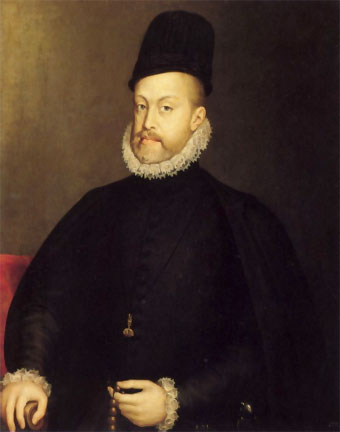
The third icon of the Spanish nationalist narrative is his son Philip II, even more sinister than his father and more relentless in the persecution of Protestants.
THE CONQUERORS OF AMERICA
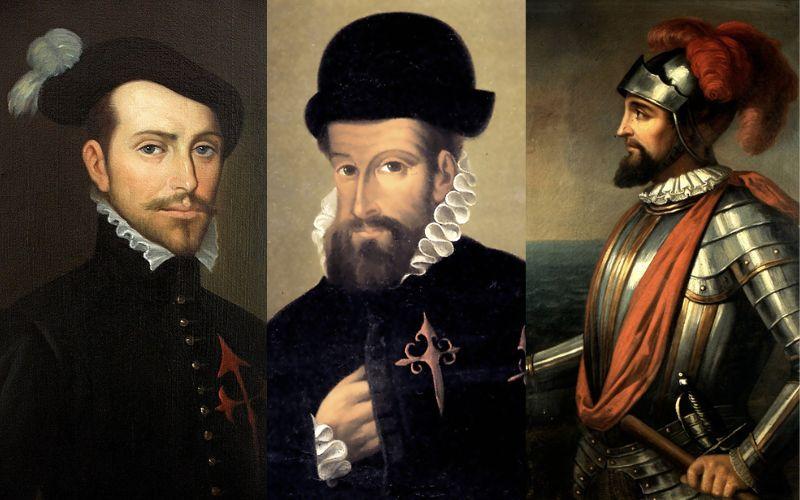
And we cannot forget the conquerors of whom some Spaniard patriots are so proud, especially Christopher Columbus, Hernán Cortés, Pizarro, or Núñez de Balboa, who were in reality vile criminals who committed great outrages against innocent people, even using cruel methods such as unleashing their killer dogs to tear apart homosexual indigenous people.
And yet, unlike countries such as France, Germany or Belgium, where there is a tendency to remove icono-villains from public spaces or recontextualize them, this civilizing process is not taking place in these lands.
Read HONOR NO VILLAIN! But rather those who have fought for a better world
Read HONOR NO VILLAIN! Julius Caesar, Dracula the Impaler…
Let’s dethrone all these evil characters and strip them of any halo of glory and grandeur. If we turn them into lampposts in the middle of the night, we will collide and hurt ourselves. Better to let ourselves be illuminated by those that work well—that is, those who have contributed to a better and happier world.
Thank you for sharing to collaborate with this noble cause,

