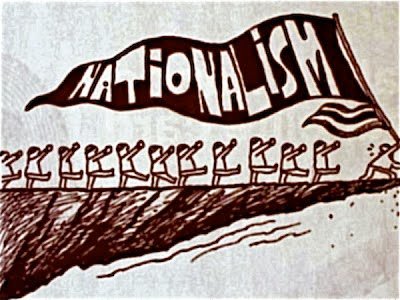
During that century, the Catalan Renaixença movement went hand in hand with the Provençal Renaixença, federated in a cultural and national resurgence that revived the language, literature, and national identity of Catalonia, Provence, and, by extension, the rest of the Catalan-Occitan countries. At that time, the prevailing idea was of a single language with different varieties extending from Limoges to Alicante.
If this changed, it was primarily due to political reasons; while in France the Renaixença was a conservative movement that maintained a purely cultural vocation without questioning French identity, in the industrial Barcelona of the late 19th century, a part of it evolved into a nationalist and activist political current.
This, along with the decline of the Limousin language in France and its devaluation as a simple “patois” spoken by peasants, led the new breed of Catalan nationalists to distance themselves from Pan-Occitanism. First, they began to convince people not to call the language Limousin, but Catalan. Pan-Catalanism gradually gained ground over Pan-Occitanism and triumphed in the 1934 manifesto “Deviations in the Concept of Language and Homeland,” which was strongly ideological and lacked scientific rigor. It claimed that the Catalan Countries and Occitania are two different nations with two different languages. It was from that moment on that the national doctrines explained above were imposed.
But the multiplicity of stories does not end there, as there is also the version that the region of Valencia is not part of the Catalan Countries and that its language is different from Catalan. And there is even more. Do you remember when Groucho Marx said in a movie? “Those are my principles. If you don’t like them, I have others”.
The same happens in the marketplace of identity pamphlets. In fact, we also find the stall of the Spanish nationalists, who sell the idea that our homeland is Spain, created by the Asturian leader Pelagius, who began the Reconquista, and culminated by the Catholic Monarchs, who finished it—another founding myth. The product they promote includes the following accessory as standard, for the same price: Catalonia is a region of Spain and not a nation.
As if we didn’t have enough offers in the real estate market of national constructions, we must add another one for sale to all those born in French Catalonia, Roussillon (referred to as Northern Catalonia by Catalan nationalists and the department of Pyrénées-Orientales by French centralists). To them, the salesmen of French nationalism advertise that their nation is France because they were born in the “Hexagon,” which since time immemorial was populated by the Gauls and was conquered by the Franks, the founders of the French state.
But the reality is that the shape of the hexagon is quite recent, and the drawing of the French state’s borders has varied greatly over the centuries.
On the other hand, the business of the Gauls is yet another founding myth, as they were simply tribes with Celtic language and culture, extending from Ireland to Turkey and from Germany to southern Portugal. Consequently, it was not a typically French element, but rather characteristic of much of Europe for several centuries. It was not so much a people that expanded through Europe replacing others, but a successful culture that spread, much like the Roman culture later would, or Anglo-Saxon culture today.
Furthermore, the identity building has other cracks, because in what the Romans called Gaul, there were other ethnic groups besides the Celts, such as the Basques from Bordeaux and Toulouse to the Ebro, the Iberians in Languedoc, the Ligurians in Provence, Germans in the northeast, or different peoples in Corsica.
And the same applies to the Franks (who gave France its name), as they conquered much of Western and Central Europe under the orders of their king/emperor Charlemagne, creating not a French empire, but a European one.
Speaking of Charlemagne, things get even more complicated because, according to the propaganda from the Catalan nationalist stall, the microstate of Andorra is part of the Catalan Countries, since its official language is Catalan. However, it turns out that the Andorran narrative is diametrically opposed to that of the Catalan patriots—almost as much as the North Pole is to the South Pole—since for that small principality, the founding event is the conquest of its territory by the Franks, specifically by their king Charlemagne. In contrast, as we saw, in Catalan nationalism the founding event of Catalonia was when the Count of Barcelona stopped paying homage to the Frankish kings.
To make matters worse, the Andorran story is as lacking in rigor as a Disney tale, as is often the case with national narratives. Proof of this is that it is very different from those existing in the territories surrounding the microstate, despite the fact that they all share most of their history, language (with variations), and ancestors.
Charlemagne was as much a conqueror of Andorra as he was of all those territories, as well as much of Europe, but in some places he has been considered a founder (as in France and Germany, where he is called Charles the Great) and in others not, such as in Spanish Catalonia or northern Italy.
According to the Andorran national narrative, Charlemagne was the Founding Father who gave them independence, but imperialist conquerors do not go through the effort of invading territories only to then grant them independence; rather, they bring them under their rule.
In fact, recent studies have confirmed that this founding legend is false. The reality was that the Andorran valleys passed from one empire (the Islamic Caliphate) to another (the Frankish). The origin of Andorran independence took place centuries later, as a result of an agreement between the Count of Foix and the Bishop of Urgell.
But in addition to all the previous stories, there are others, such as that of the European Union (which is in fact gaining more and more strength), Europe, the West and the white race. And even, if we felt like it, we could set up new stalls in the Grand Bazaar of identity narratives, such as the irredentism of all the territories of the former Kingdom of Aragon, Iberia, Pan-Hispanism, all countries with Latin languages, those that were part of the ancient Roman Empire, the Visigothic Kingdom, the Kingdom of the Franks, and a long etcetera.
Or, why not? We could drop a drop of oil on Catalonia on a map of Europe and claim that the nation’s borders are the outline of the resulting stain. Can you think of any other offerings to add to the identity catalog?
To make things worse, it turns out that the Catalan nationalist doctrine is intended to be applied to a population that mostly originates from the rest of the Spanish state and other countries in Europe, Latin America, Africa and Asia, since we Catalans descended from indigenous families are a minority in our own land. These are very diverse people who are being led to believe—both them and especially their children—that we actually have much in common because Count Wilfred the Hairy stopped paying homage to his king more than 1,000 years ago.
I suppose that with so many parallel stories, readers must feel somewhat confused, and some may wonder: which of them all is the most correct? They are all mere mental constructs created by specific people at certain moments in history. Basically, their merit consists in having successfully managed to get many others to internalize their invention, usually thanks to the indoctrination of children in schools.
The most accurate view of objective reality is that in Catalonia, as in the rest of the planet, what exists are states and administrative regions, languages, cultural patterns shared by different people, beliefs, and identity feelings. And above all, there is a large number of individuals (human and non-human), with differences and similarities between them, regardless of the group with which they identify.
Instead of obsessing over supposed nations, we should focus on protecting the individual (regardless of their nationality, ethnicity, race, or even species), defending their rights and freedoms, and promoting their well-being and happiness.
To achieve a better world, it is preferable to blur identity borders rather than place mental walls that separate us from one another and even, at times, drive us toward hatred and aggression. It is more useful for everyone to build bridges than psychological barbed wire.
Questioning nationalist legends will help our minds be open like a C (for cosmopolitan) instead of closed like an O (for obtuse). If we want to create emotional and relational distance, let it be toward those who stand out for harming others. But let us never do so toward people and other creatures who are reasonably good, regardless of where they were born or live, even if it is at the end of the world. And also without prejudice to the language they speak, however rare it may be, like that of the San, who communicate with clicks between the tongue and the palate.
Thank you for sharing if you believe this analysis can help prevent the harm that ultranationalism periodically causes.





 GIFT:
GIFT: